


TrackJet’s guide to reading an air cargo timeline picks one mistake as the easiest to make. A shipment flying Frankfurt, Doha, Singapore produces an RCF line at Doha, and on TrackJet’s reading, anyone who takes it as “it’s arrived” is looking at goods in a transit shed. The air cargo status codes on that page come from one standard. The guides that explain them disagree on what several codes promise, starting with RCF.
Where the status codes come from
The codes travel in the FSU (Status Update) message of Cargo-IMP, IATA’s messaging standard. Per the Flaks glossary, each FSU carries one status event with a date, time and location, sent against a specific air waybill. The final Cargo-IMP edition, the 34th, took effect on 1 January 2015, and Flaks says the standard is frozen, with Cargo-XML’s XFSU message carrying the same 21 codes.
I did not open the manual itself. The Cargo-IMP status codes quoted below are Flaks’s account of its Code List Grid (section 1.18), so where Flaks and another guide differ, you are comparing one glossary against another.
RCF and ARR: read the station, not the code
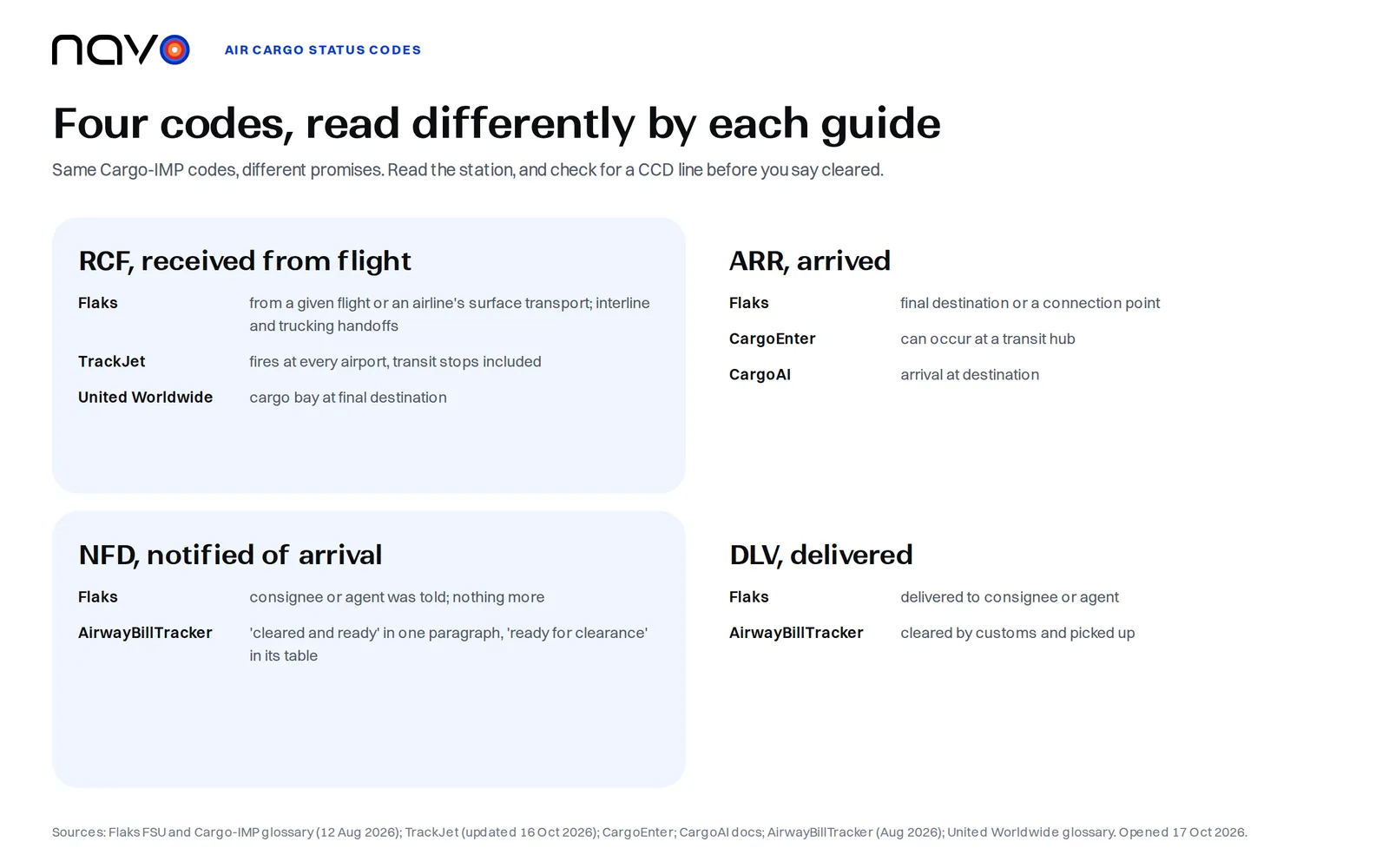
The RCF meaning in air cargo depends on whom you ask. Flaks quotes the standard’s wording as “physically received from a given flight, or the surface transport of a given airline” and then describes it as the code that fires at interline and trucking handoffs. TrackJet says it fires at every airport, transit stops included. AirwayBillTracker puts it at unloading at a transit point or at the final destination. United Worldwide’s glossary labels it a Cargo 2000 milestone and ties it to the cargo bay at final destination.
A definition tied to the final destination and a definition that includes transit airports cannot both describe the RCF DOH line. The quoted standard wording names no destination at all, and Flaks’s interline gloss is narrower than the sentence it quotes. My working rule follows from that: the airport code beside RCF decides whether it is your airport, and the three letters alone decide nothing.
ARR splits the same way. Flaks says the location may be the final destination or a connection point. CargoEnter says an AWB travelling through a hub should be read as individual flight legs, and that arrival is not collection or delivery. CargoAI’s documentation describes ARR as arrival at destination.
A normalised timeline gets tested right here, on how much of each line it keeps. AirCargoMCP at Navo resolves one 11-digit AWB into a Cargo-IMP timeline (RCS, DEP, RCF, NFD, DLV), with the airline detected from the three-digit prefix. Each milestone carries the flight number, station, piece count and gross weight, which is enough to tell RCF DOH from an RCF at the destination. The page also says only observed milestones are reported, so a shipment that has not moved does not read as delivered.
TrackJet treats the gap between two air cargo tracking milestones, ARR and RCF, as the first useful warning on a timeline: many hours without RCF is, in its words, an early-warning signal, because unloading, transfer to the cargo terminal and acceptance scanning take real work. That reading assumes TrackJet’s definition of RCF, a check-in at the arrival warehouse, and holds only as far as your airline’s usage matches it.
NFD does not say customs cleared
AirwayBillTracker contradicts itself on this one. Its lifecycle paragraph puts a customs hold and release before NFD and calls NFD a notice that cargo is “cleared and ready for physical collection”. Its glossary table says “ready for clearance and collection”, and its section on what happens after NFD lists customs hold as the next status.
Flaks defines NFD as notification only: the consignee or its agent was told the cargo arrived, and nothing moves. Customs has its own codes in the same table, CRC for reported to customs and CCD for cleared by the customs authorities. CargoAI lists customs inspection (CUS) and cleared (CCD) as separate events as well. AWR is a second collision. Flaks defines it as arrival documentation received, while AirwayBillTracker calls it “held by customs”.
So an NFD line is evidence that somebody was told. A clearance claim needs a CCD line or the broker’s release, and CargoEnter notes that CCD usage also depends on the carrier. TrackJet goes further and says a shipment that seems stuck after NFD is almost never waiting on the airline, so the question goes to the broker. The AirCargoMCP page lists five milestones (RCS, DEP, RCF, NFD, DLV) and names no customs code.
DLV carries the same ambiguity. AirwayBillTracker writes it as cargo cleared by customs and picked up. Flaks defines it as physical delivery to the consignee or the consignee’s agent, with no mention of clearance.
Some codes are not on the list at all
Flaks’s table has 21 codes, and the AWB status codes you meet on a tracking page are judged against it. OFF (offloaded), CUS, CLD (cargo loaded) and SOH (shipment on hold) appear in CargoAI’s list and not in Flaks’s. AirwayBillTracker’s glossary adds TRNS, MSCA, DLT, DMG, HLD and RET, none of which are in Flaks’s table either. None of the pages I read says which of those codes the airlines send and which the tracking platforms add. Before you act on an AWB status code that is missing from the Cargo-IMP table, ask which of the two sent it.
Frequently asked questions
Does RCF mean my air shipment has reached its destination?
Not by itself. The Cargo-IMP wording Flaks quotes names no destination, and TrackJet says RCF fires at every airport. United Worldwide's glossary reads it as the cargo bay at final destination. Compare the airport code on the line with the consignee's airport.
What is the difference between DLV and DDL on an air waybill?
Per Flaks, DLV is physical delivery to the consignee or the consignee's agent, and DDL is delivery to the consignee's door. TrackJet adds that door delivery bought as a separate leg may not appear on the airline's page at all.
Why does one AWB show several DEP and ARR lines?
CargoEnter says the cargo may travel across several flight legs and hubs under the same air waybill, and that a hub stop should be read as an individual leg. It also says arrival is not the same as collection or delivery, so DLV or an equivalent delivery event is what marks completion.